
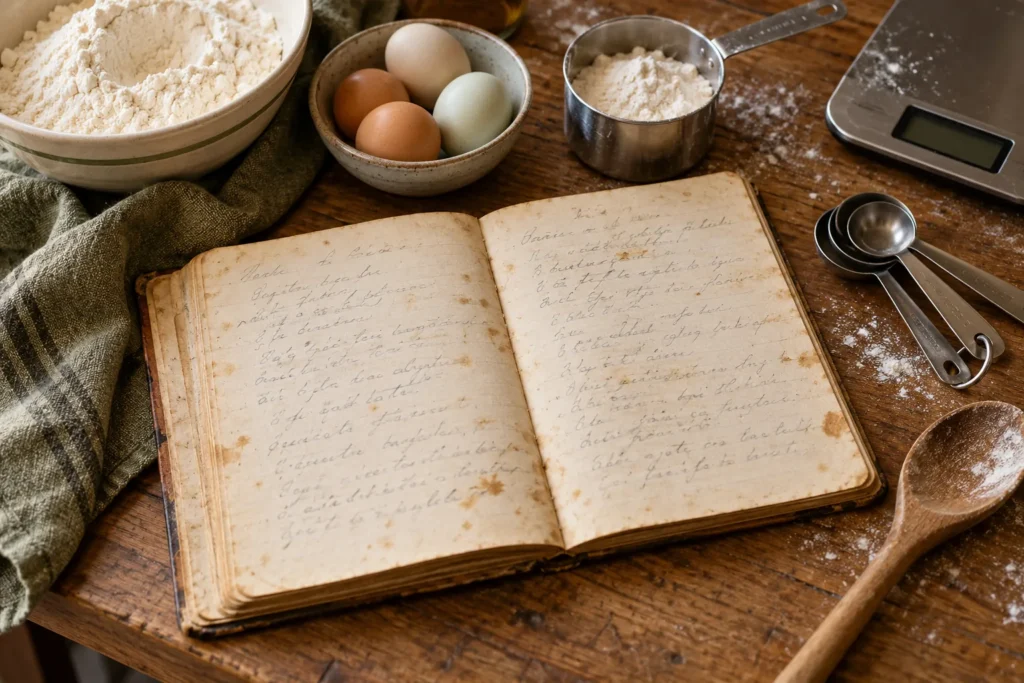
An old recipe can preserve more than a dish. It can show the ingredients a contributor used, the way a cooking community shared instructions, and the assumptions that once passed without explanation. It can also contain incomplete directions, mixed measurement systems, or a link to a video that no longer plays. Reading it well means paying attention to what is actually present.
That does not require treating every uncertainty as a reason to abandon the recipe. It requires a sequence: identify the source, read the whole method, compare the ingredient list with the directions, and decide which questions need answers before cooking. Keep your own adaptations separate from the historical text so another reader can follow the same distinction.
Identify the version you are reading
Look for a contributor’s name, a publication date, a source link, and any note explaining how the page was recovered. Those details may point to different moments. The date of an Internet Archive capture is the date a page was saved, not necessarily the day the recipe was first published or last revised.
A recovered page may also come from an earlier version of a website. The Coto Makassar recipe, for example, was recovered from the Foodlve predecessor at the same path later linked on The Cherry Share. Its source note identifies that version. It does not claim that every later revision has been found.
When you save a recipe for personal use, record the version you read and keep its source note. That makes later comparisons useful. If an ingredient changes between copies, you can describe the difference rather than combining two versions without saying which instruction came from where.
Read the method before measuring anything
An ingredient list alone cannot tell you the order of preparation. Read through to the end and identify every rest, chilling period, heating step, and piece of equipment. A title that sounds quick may lead to a method with several separate stages. An ingredient that seems ready to use may need advance preparation.
Make a short task list in the order the work will happen. Include actions mentioned inside other steps, such as reserving liquid, cooling a mixture, or setting aside part of an ingredient. This is especially useful when an older page places all the directions in one paragraph rather than separating them into numbered steps.
Then check the method against the ingredient list. Each important ingredient should have a recognizable role, and every ingredient called for in the directions should appear somewhere in the list. A mismatch is a question to investigate. It is not a reliable invitation to guess a missing quantity.
Keep weight and volume separate
A gram describes mass; a milliliter describes volume. A cup of one ingredient does not necessarily weigh the same as a cup of another. The National Institute of Standards and Technology’s culinary measurement guidance recommends measuring ingredients by mass with an appropriate kitchen scale to improve accuracy.
That recommendation does not make an unexplained conversion in an old recipe automatically correct. If a source supplies both cups and grams, compare the intended ingredient and measuring method before choosing one set of instructions. Avoid taking a number from one system and another number from the other simply because each looks convenient.
Choose a consistent working version and write down which system you followed. Keep the source’s original measurements in your saved copy. If you later adjust the recipe, that record helps distinguish a measuring choice from a change in ingredients, equipment, or technique.
Pay attention to the way an ingredient is measured
Words such as chopped, sifted, packed, drained, and melted can affect what a measurement means. Read where they appear and look for clarification in the method. A recipe that expects a prepared ingredient is asking for something different from a recipe that measures an ingredient before preparation.
Canada’s Food Guide explains measuring techniques for liquids, dry ingredients, thick ingredients, and small amounts. Its dry-ingredient guidance uses a spoon to fill the measuring cup and a straight edge to level it, rather than scooping the cup into a bag and packing in more flour.
For a recipe with no measuring explanation, first check the creator’s linked source. A short introduction or photograph may clarify the intended preparation. If the detail remains uncertain and would affect the result substantially, use a more complete recipe for cooking and keep the old page as a reference.
Notice missing information without inventing it
Some historical pages were built around a video, an image, or a link to the creator’s website. The text on the page may never have been intended to stand alone. Recovering that text faithfully can reveal an ingredient list without recovering the accompanying method.
The archive’s dark chocolate avocado cookie page is a useful example. Its recovered text contains ingredients and a video reference, but no complete written preparation method or oven temperature. A restoration note makes that limit explicit. Supplying a plausible temperature would create a new instruction rather than recover an old one.
If you develop your own method from an incomplete reference, identify it as your adaptation. Describe the ingredients and steps you actually used, and avoid attributing your decisions to the original author. That keeps credit accurate and gives the next cook a clearer record.
Treat dietary labels as claims to check
A recipe title may describe a dish as vegan, gluten-free, healthy, or suitable for a particular diet. Read the ingredients instead of relying on the title. Check packaged ingredients and any substitution you intend to use. A label in an archived headline does not verify the suitability of a dish prepared today.
The archived raw chocolate cake page includes a source note about an inconsistency between its vegan label and an ingredient. Keeping that note beside the recipe helps a reader see the problem. Removing the ingredient silently would make the page look more consistent while obscuring what the source actually said.
Apply the same care to storage and preparation. Contemporary food-safety guidance should govern the meal you make. Historical wording is evidence of what a page contained, not proof that every instruction remains appropriate.
Use photographs as context
A photograph can help show how a finished dish was presented, but it cannot establish an ingredient quantity or prove that a method was tested. A new illustrative image is even further removed from that evidence. Look for a credit identifying whether the picture was recovered from the same page, saved by a referring website, or created as a replacement.
If the photograph is missing, evaluate the written instructions on their own. Do not let a polished replacement image fill gaps in the method. When a page says that an image has not been recovered, that is useful information about the record, not a missing step in the recipe.
Keep a practical cooking record
After choosing a complete and suitable recipe, make a few notes that will help with a second attempt. Record the measurement system, the pan you used, substitutions, and the instruction you found ambiguous. Describe the result plainly: whether the mixture was loose, whether the portion size suited your pan, or whether a step needed more explanation.
Change one important variable at a time when you are trying to understand a result. Several simultaneous substitutions make it harder to know which decision mattered. Keep your cooking notes separate from the archived wording, and credit the source whenever you share an adaptation.
The recipe collection brings together pages with different levels of completeness. Reading their source notes along with their ingredients lets you enjoy the collection while making a sound decision about what to cook. A useful archive can preserve an imperfect page and still help a present-day reader recognize its limits.