
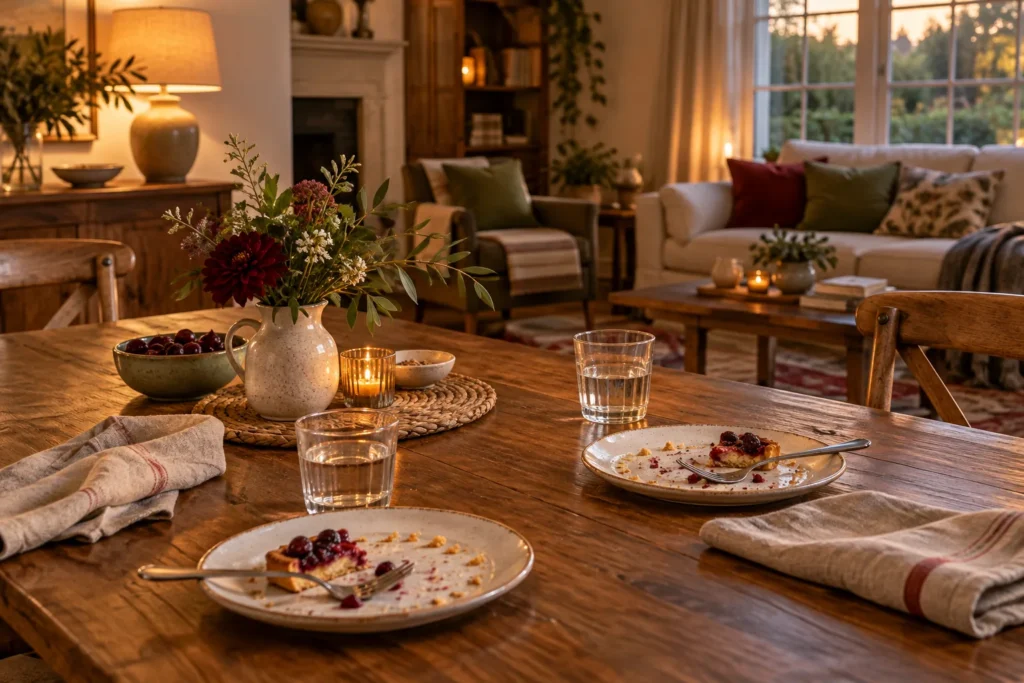
You know the moment. The last fork goes down, somebody leans back in their chair, and the dishwasher can wait. Nobody has a train to catch. Hosts often panic a little here and reach for some grand next act. Honestly? Put the kettle on and sit back down.
Something sweet on a little plate helps. Cushions help more. Keep an idea or two in your back pocket for when the chat runs dry, and that’s about it.
Look around the table before you decide anything. One friend will happily talk until midnight. Another might perk up the moment you put a record on, and somebody’s teenager will quietly wish they could go and play something on a screen. Let them. Nobody came round to be herded through a group activity like it’s a team-building day at work.
Let dinner set the pace
Hosting? Then the menu quietly decides whether you’ll be at the party or just catering it. Pick something fussy and you’ll hear the best story of the night from the kitchen, through a cloud of steam. Ask anyone who’s ever made risotto for eight.
Dishes that sit happily in a low oven are a host’s best friend. A braise that’s better made the day before. Lasagna you built at lunchtime. Roast veg on a tray. Scribble a prep list a couple of days out and count your serving dishes, because it’s always the serving dishes. Anything that can be done before the doorbell goes, do it then.
We’ve got a whole piece on hosting a make-ahead supper if you want to plan the menu properly, right down to where every dish will land. Borrow what’s useful. Then be realistic about your oven, your evening and the three pans you actually own.
Dessert can be optional
Nobody’s going to mind if a big dinner isn’t followed by an equally big pudding. In fact, after a hearty main, a lot of people would rather have a few bites of something than a towering slice.
Try putting out one small, easy thing. Vanilla ice cream with a shot of hot espresso tipped over it is about as easy as dessert gets, and it looks fancy. Shortbread and a bowl of clementines works. So does a bar of dark chocolate snapped into chunks on a board. Just flag the nuts and the dairy, and let people wander over when they feel like it.
Plating one dessert beats juggling three dishes on a table that’s already full of glasses. Got a guest who skips sugar? A wedge of cheese, a few crackers and some grapes keeps them in the game without anyone making a fuss. It also means fewer things to wash up at eleven o’clock at night, which future you will appreciate.
A note on old recipes
Rummaging in our archive? Have a proper read of the historical chocolate cake recipe first. The old title says vegan. The ingredients say honey. If you’ve got a vegan guest coming, that’s not a small thing, so check any recipe against who’s actually eating before you hit the shops.
Filling the next hour (or not)
This is where a slow evening finds its shape. Not with a timetable, just a handful of gentle options.
Board games are back, if they ever really left. Lockdown in 2020 sent half the country digging through the cupboard under the stairs for Monopoly money, and lots of those boxes never went back in. After a big meal, though, keep it light. Codenames is great. So is whatever card game your family has been arguing over since 1994. Save the four-hour strategy epic for another night.
Music helps too. Keep it low, though. If anyone’s raising their voice to be heard, it’s too loud. Other nights there’s no game and no music at all, just a refilled teapot and a conversation that ends up somewhere nobody expected.
New game for someone? Give them the thirty-second version, deal, and tell them they’re welcome to just watch this round. Not every pause needs filling. Some of the nicest moments happen when nobody’s trying to entertain anyone.
When someone wants their own thing
Some guests just want ten minutes on the sofa with their phone after a rotten week at work. Let them have it. If somebody prefers to do something on their own, look at online entertainment options separately from the shared plan.
It’s worth a little care here. Have a proper look at what a service actually does before signing up for anything. The terms matter, so do any age requirements, and so do any charges, far more than how inviting the front page looks. That’s especially true if younger guests are involved. And a link in a lifestyle article like this one is never a substitute for checking those details yourself.
There’s a middle ground, too. Party games played on phones, where everyone uses their own handset as a controller, have become a popular way to bring the screen-lovers and the talkers together in one room. Done right, the phones actually make the evening more social, not less.
When there are kids at the table
Evenings with children in the mix run on a different clock. Little ones tend to be done with sitting still roughly four minutes after the last bite of dinner. So it helps to have something ready for them that doesn’t drag the grown-ups away from the table. A stack of coloring sheets, perhaps, or a jigsaw spread out on the floor in the next room.
Older kids are trickier, and often more fun. Uno across three generations is a joy, mainly because the nine-year-old will show Grandad no mercy whatsoever. With a wide age gap, go for games with a bit of luck in them. That way the youngest still has a real shot.
Bedtimes are worth planning around, too. If a younger guest needs to be home by eight, start the shared game early and save the slower, chattier part of the evening for after they’ve gone. Nobody minds a host who thought ahead.
Clear the decks
Red wine and a cardboard game board are not friends. Coasters, by the way, are hugely underrated. So is a tea towel within arm’s reach. So clear the dinner plates before the cards or boxes come out. Give drinks a stable spot of their own, ideally a little away from where the action is. Put out napkins, but not on top of the playing surface.
A nearby side table, or even the kitchen counter, can hold the snacks and serving dishes. That leaves the main table clear for whatever you’re doing, and it means people have a reason to get up and stretch their legs now and then.
For more practical ideas on the food side, take a look at snacks for a relaxed game night. Its suggestions about small portions and keeping food in its own space work just as well for an evening with no formal game at all. Little bowls beat one giant platter. Things you can eat with one hand beat anything that needs a knife and fork.
Lighting does more than you’d think
Overhead lights left on full can make a dining room feel like an office after dinner. Switch to a couple of lamps instead. Keep enough light on the table for people to read their cards, and let the corners of the room go soft. It’s a small change, but it tells everyone, without a word, that the evening has shifted into a slower gear. Candles are lovely too, as long as they’re nowhere near a stack of cards or a toddler’s elbow. Battery tea lights are a perfectly respectable cheat.
Why the slow evening is having a moment
Having people round has changed a bit lately. The big candlelit five-course production hasn’t vanished, but plenty of hosts would now rather do a pot of something, a couple of games and home by ten. Remember when everyone was suddenly talking about hygge? The Danish word caught on partly because it gave people a fancy-sounding excuse for exactly this sort of night in.
It also takes the pressure off the host. You’re not putting on a show. Nobody’s marking the pudding out of ten.
Winding down
By the second pot of tea, someone will usually say “one more round?” Make that the last one. Or call it when the chocolate runs out. Leave yourself a bit of time to clear up, and please don’t crack open a two-hour board game while people are hunting for their car keys. We’ve all been to that party.
The night doesn’t need a big finale. There’s no closing speech, no grand last course. Sharing a meal and then simply enjoying each other’s company for a while is already a complete plan, and honestly, it’s usually the part people remember on the drive home.
Before settling into the rest of the evening, put perishable dishes away. FoodSafety.gov’s guidance on chilling and storing food explains refrigerating leftovers promptly while you make space for conversation or another activity.